
FUE Hair Transplant Recovery Timeline: What to Expect from Day 1 to 12 Months
How long does it take to recover after a FUE hair transplant? Recovery from a FUE hair transplant takes about 7–14 days for the scalp to heal and for scabs to fall off. The tiny punch marks left behind in the shaved-short donor area from hair graft extraction usually become barely visible within a few weeks as they heal and fade and the native hair starts regrowing.
Because FUE is minimally invasive, it avoids the thin linear scar associated with strip surgery (MDEE/FUT). Instead, recovery is quicker, pain is minimal, and most patients return to much of their normal routines within a week. The small wounds close quickly, and healing is generally smooth when you follow post-op instructions.
In the following article, we discuss what recovery from a FUE hair transplant looks like with real patient photos, how to minimize FUE scars, and answers to the top questions about FUE recovery.
FUE Hair Transplant Immediately After Surgery
Immediately following surgery, the scalp will have small red dots where the donor hair grafts were extracted and where those hair grafts were transplanted. Mild swelling, redness, and tightness are normal. Tiny scabs will begin to form around each transplanted hair graft within the first 24 hours.
To minimize swelling, patients are advised to sleep with their head elevated at a 45 degree angle, directed to massage their forehead and temple area daily, to avoid looking down at their phones or computers, and to resist touching or scratching the scalp. Pain is usually minimal and managed with over-the-counter medication if needed. The first few days are the most delicate, so protecting the hair grafts and following aftercare instructions closely is essential.
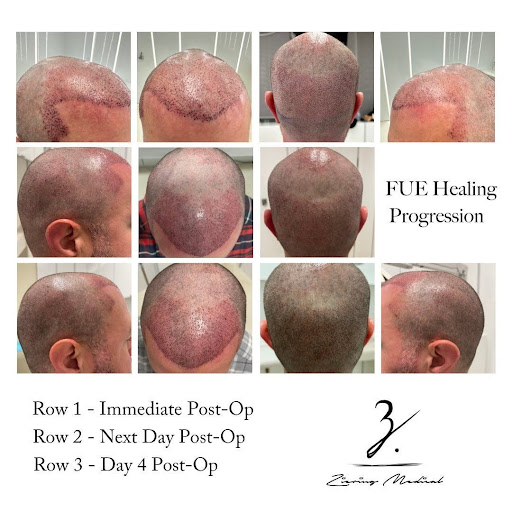
Healing progression after FUE surgery showing immediate, next day, and day 4 post-op
FUE Hair Transplant After 7 Days
By day 7, most of the redness and swelling have faded. Scabs begin to loosen and fall off naturally with gentle washing. The donor area is largely healed, and the grafts are secure. Patients can usually return to work and light daily activities at this stage, though strenuous exercise should still be avoided.
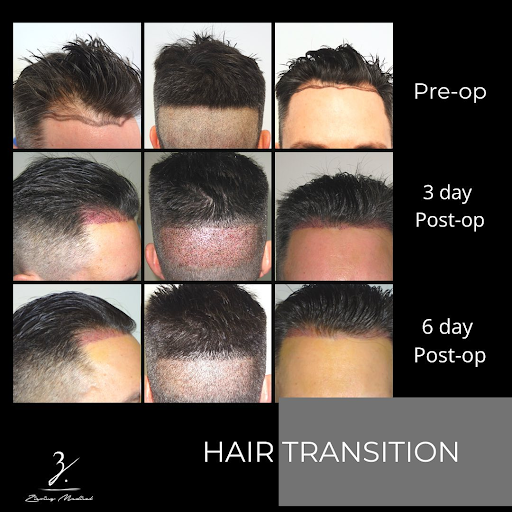
FUE before and after photos showing healing in the donor and recipient area 1-6 days post-op
FUE Hair Transplant After 1 Month
Around the one-month mark, most transplanted hairs will shed in a process called shock loss. This is expected and means the follicles are entering a resting phase before new growth begins. The scalp is fully healed, with donor area punch marks barely visible. While the shedding can be concerning, it is a normal part of recovery and sets the stage for regrowth in the coming months.
FUE Hair Transplant After 2 Months
At two months, the scalp is healed but most patients see little visible change. The transplanted follicles remain in their dormant phase after shedding. It can look like there has been no progress, but this is a normal part of the cycle. New growth is preparing to emerge, typically starting around the third or fourth month.
FUE Hair Transplant After 3 Months
By the third month, you may see early signs of new growth begin to appear. Fine, thin hairs start emerging in the transplanted areas. Growth can look patchy or uneven at this stage, but it signals that the follicles are active again. Patients may also notice some lingering shock loss in native hairs, which typically stabilizes as regrowth continues. Keep in mind, this is just the beginning; there is more growth to come!
FUE Hair Transplant After 5 Months
At five months, growth becomes more noticeable. Transplanted hairs start to thicken and cover more of the treated areas. Density improves, but results are still developing and may look uneven. Many patients begin styling their hair with more confidence, though full results are still several months away.
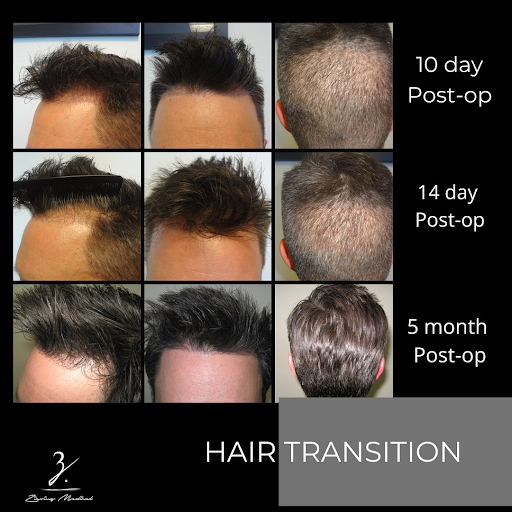
FUE before and after photos showing healing and regrowth in the donor and recipient area 10 days, 14 days, and 5 months post-op
FUE Hair Transplant After 6 Months
By six months, nearly half of the final result is typically visible. Hair is noticeably thicker, stronger, and more consistent across the treated areas. Some patients are satisfied with their appearance at this stage, but continued growth and maturation are expected in the months ahead. On the one hand, the wait for the mature result may be frustrating. On the other hand, the subtle, gradual growing-in of the transplanted hair is slowly changing your appearance in a way that no one will be able to figure out that you have had surgery or why you are looking younger with every passing month.
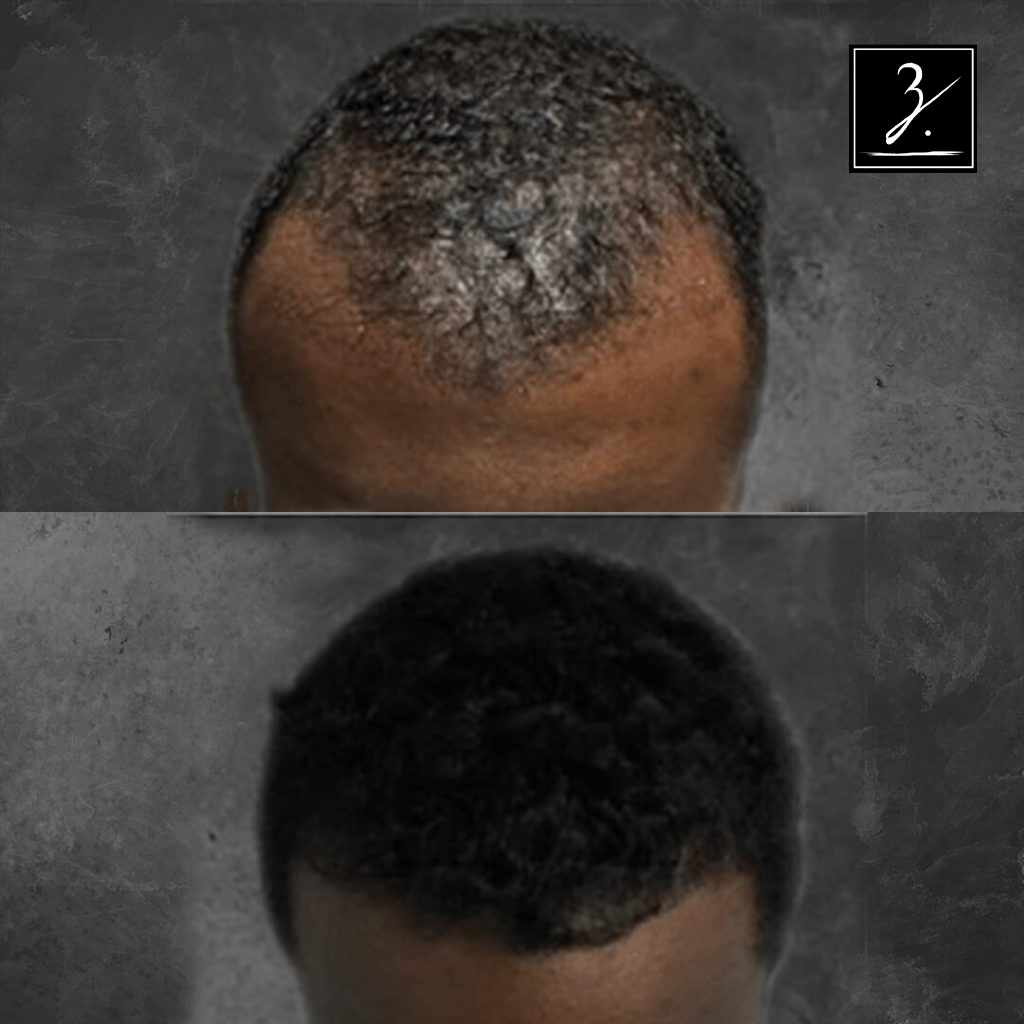
FUE hair transplant (1500 follicular units) 7 months post-op
FUE Hair Transplant After 12–18 Months
At 12 months, many patients see their final results. The transplanted hairs have matured, thickened, and blended naturally with existing hair. Density is at its fullest, and the hairline looks permanent. In some cases, crown areas may continue to improve up to 18 months, but by one year, much of the transformation is essentially complete.
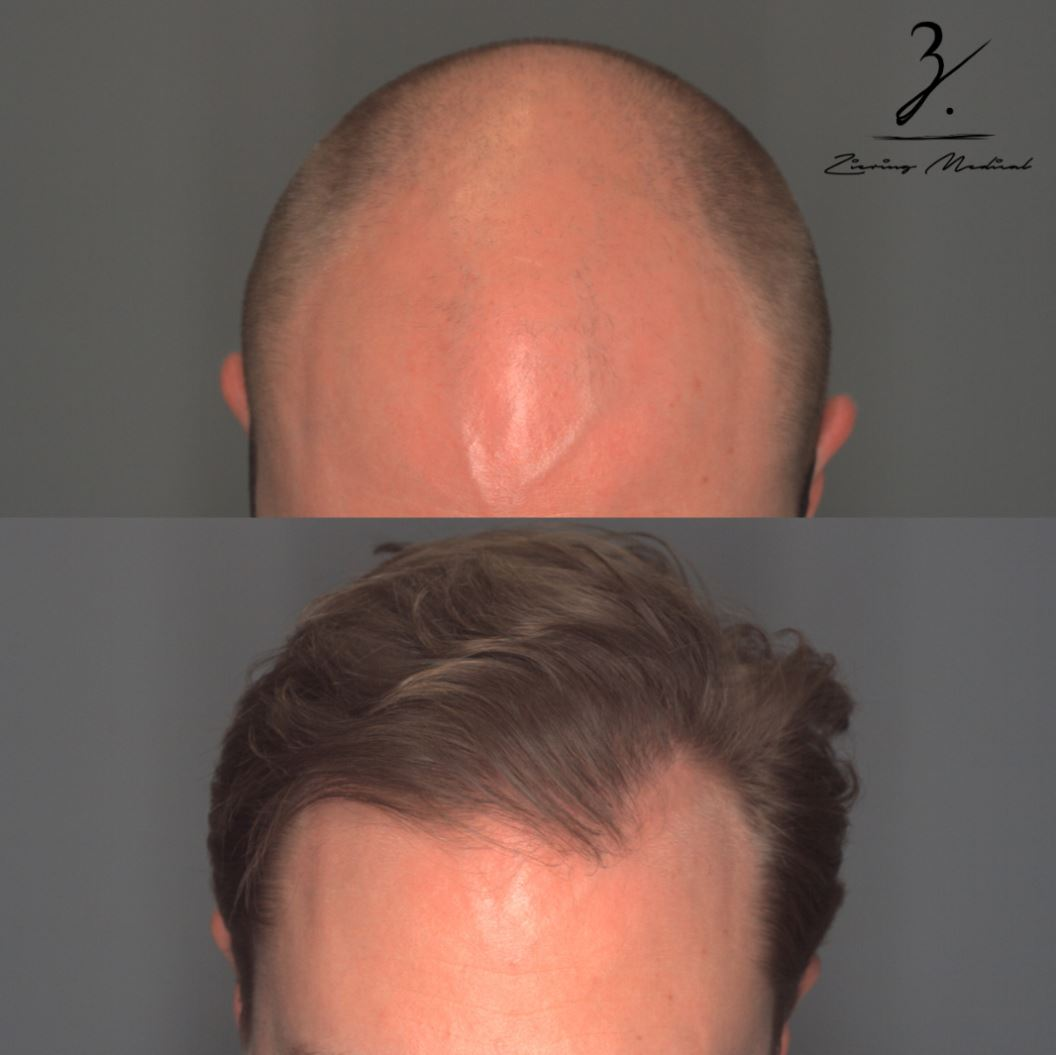
FUE hair transplant (2800 follicular units) 10 months post-op
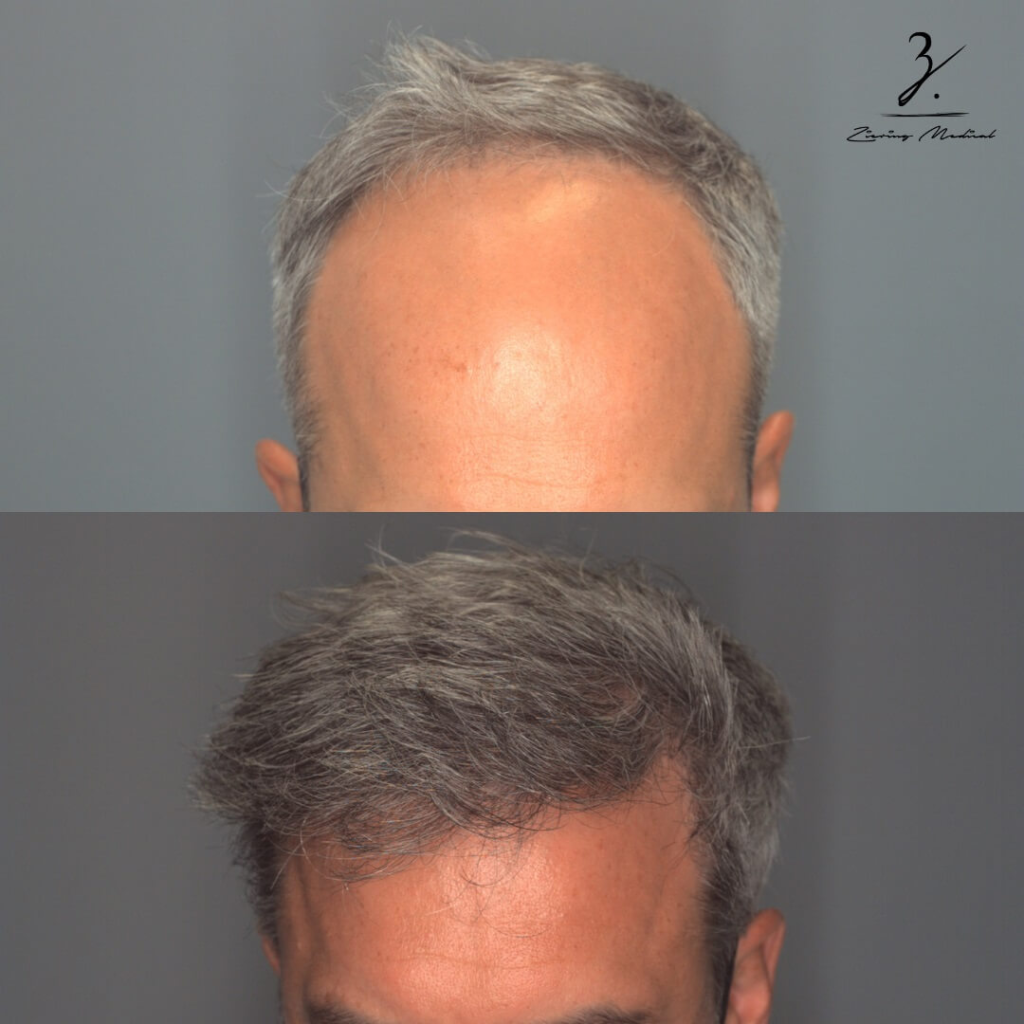
FUE (2031 follicular unit) 12 months post-op
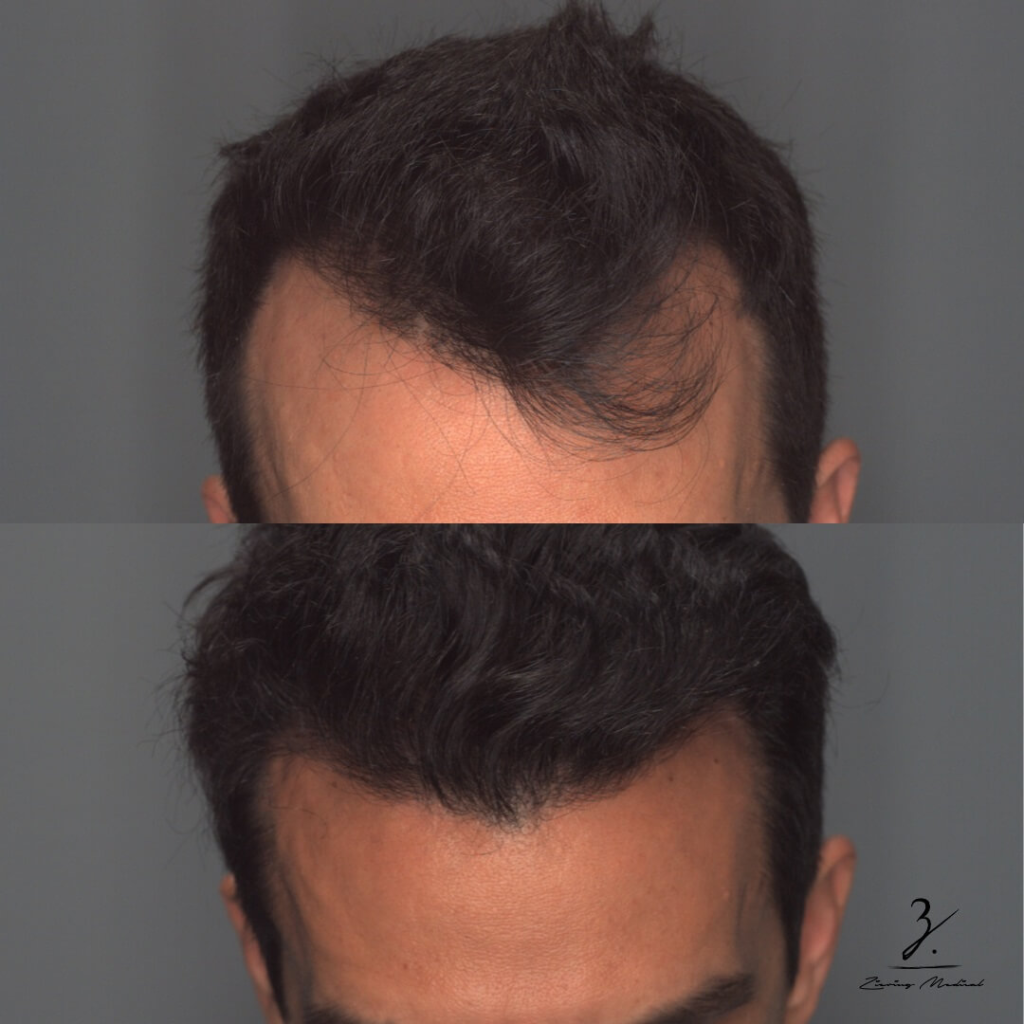
FUE hair transplant (2520 follicular units) 14 months post-op
How to Minimize FUE Scars
Scarring with FUE is minimal, but results depend heavily on your surgeon’s skill and the overall surgical plan. An experienced surgeon performs a safe donor harvest, extracting hairs within the safe donor zone only where the hair is permanent, avoids over-harvesting the donor area, and artistically removes donor grafts throughout the donor area so as to prevent the donor area from appearing too thinned out. Further, an experienced surgeon uses the right punch size for the donor hair extraction and the advanced surgical blades for recipient site creation. Attention to detail is everything when it comes to delivering a natural result – from planning a safe donor harvest to creating recipient sites at the proper angle, orientation and direction to ensure that the transplanted hair will match your natural hair growth patterns. Another consideration in well-planned hair transplant procedures, is the spacing between recipient sites needed to reduce trauma, allow hair grafts to benefit from healthy blood flow, and avoid visible marks or potential scarring. Poor recipient site creation or over-harvesting can produce less than optimal results with patchy donor areas and visible permanent scars or reduced graft survival with transplanted hairs and hair growing in the wrong direction.
When choosing a surgeon or clinic, ask direct questions to ensure scarring will be minimized:
- What punch size and technology do you use for extraction?
- How do you avoid over-harvesting the donor area?
- Who will be performing the extractions?
- Note: Extractions should always be performed by a doctor. Qualified technicians may assist with graft handling, preparation, and sometimes implantation under the surgeon’s supervision, but they should not perform extractions or recipient site creation.
- Can I see before-and-after photos of patients with short hairstyles?
- How do you plan graft harvest to protect the donor supply long-term?
At Ziering Medical, our board-certified surgeons bring more than 75 years of combined surgical experience in FUE and FUT hair restoration, with over 100 million grafts transplanted and more than 50,000 successful procedures. Our natural-looking results and commitment to patient care set us apart as one of the best hair transplant clinics in the U.S.
Call us or visit a Ziering Medical clinic near you to book a consultation. We offer in-person and virtual consultation for patients all over the greater Tri-state area of New York, New Jersey, and Connecticut, as well as the greater Southern California area from Los Angeles and Beverly Hills to Newport Beach and San Diego. We also offer consultations for patients in and around Salt Lake City and West Palm Beach.
Frequently Asked Questions
When can I safely resume normal activities or return to work?
Most patients can return to desk work within 3–5 days, as long as they’re comfortable with mild redness or scabbing. By 7–10 days, the scalp looks normal enough for most social and professional situations. Strenuous activity, heavy lifting, and exercise should wait at least 7 to 10 days to protect the grafts and allow proper healing.
How should I manage scabs or crusting?
Scabs form naturally around each graft in the first week. They should be left alone to fall off on their own. This usually happens around or by day 10. Gentle washing as instructed by your surgeon helps loosen them without damaging the grafts. Picking or scratching should be avoided, as it can dislodge grafts and slow healing.
Is travel safe immediately after the procedure?
Travel is best avoided during the first few days after surgery when the grafts are most delicate. Short trips by car are usually fine if you avoid bumping your head or putting pressure on the scalp. Air travel can be safe after several days, but patients should consider swelling, exposure to crowds, and the need to follow aftercare routines. Whenever possible, it’s recommended to stay local for the first week.
How long until recovery looks “natural”?
Most patients look presentable within 7–10 days once scabs have fallen and redness fades. By one month, the scalp appears fully healed, though shock loss can make the hair look thinner. Around 3–4 months, new growth begins appearing, and by 6 months, the early results are becoming slowly visible. The natural, mature look is achieved between 12–18 months.
Is shock loss or shedding normal after a FUE hair transplant?
Yes, shock loss is normal. In the first month, most of the transplanted hairs fall out as part of the healing cycle. This does not mean the grafts are lost. The follicles remain intact under the skin. New growth typically begins around 3–4 months, first as fine hairs, then gradually thickens. More noticeable hair growth builds by 6 months, with full results developing between 12–18 months.